
WhatsApp Bill Payment India: How to Pay Electricity, Gas, and 22,722 More Bills Directly on WhatsApp
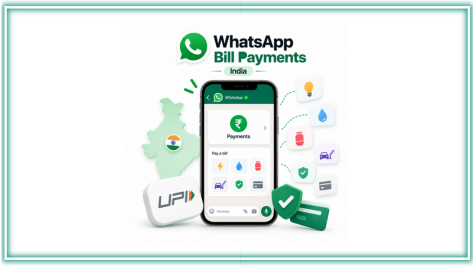
Table of Contents
Introduction
India has 500 million WhatsApp users. Until September 3, 2026, every single one of them left WhatsApp to pay a bill. They opened PhonePe, Google Pay, BHIM, or their bank’s app, found the biller, entered the account number, and paid. WhatsApp Bill Payment India changes that. As of September 3, 2026, you can pay electricity, gas, water, FASTag, insurance, credit card, and loan bills without leaving WhatsApp, connected to 22,722 billers across 30 categories through the Bharat Connect network.
What WhatsApp Bill Payment India Does
WhatsApp Bill Payment India launched on September 3, 2026, as confirmed in Meta’s official announcement. The feature is powered by the Bharat Connect network, India’s interoperable bill payment infrastructure, previously known as the Bharat Bill Payment System (BBPS).
The feature lives inside WhatsApp’s existing payments section. You tap the ₹ icon at the top of your WhatsApp home screen and land on a Payments Home screen that is specifically designed around bill management, not just money transfers.
Payments Home does three things that make it more useful than a basic payment screen. First, it pre-fetches your outstanding bills automatically after you link your accounts, so you see what is due without searching. Second, it keeps your recently paid billers one tap away so you do not re-enter your consumer number every month. Third, it lets you manage multiple accounts under a single provider, which matters for households paying electricity bills for a home, an office, and a rental property all in one place.
Payment is available through UPI, debit card, or credit card. The same payment options you have in the rest of WhatsApp Pay apply to bill payments.
What WhatsApp Bill Payment India Covers: 30 Categories, 22,722 Billers
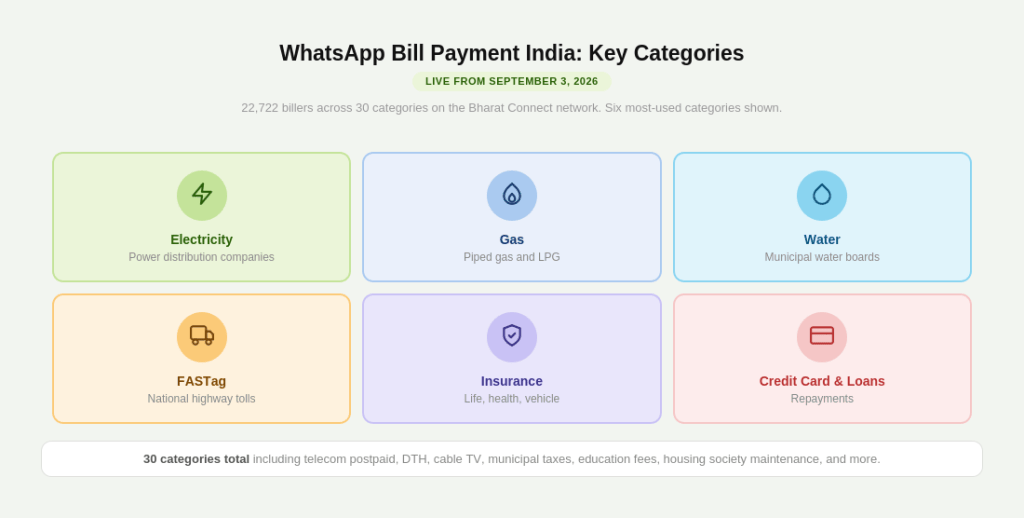
The breadth of the Bharat Connect integration is what makes this launch significant. At 22,722 billers across 30 categories, WhatsApp Bill Payment India covers a larger biller network than most standalone payment apps offered at launch.
The categories available at launch include:
- Electricity boards across all states
- Piped gas providers and LPG connections
- Municipal water boards
- FASTag for national highway toll payments
- Life insurance, health insurance, and vehicle insurance premiums
- Credit card bill payments for major card issuers
- Loan repayments including home loans, personal loans, and vehicle loans
- Telecom recharges and postpaid bill payments
- DTH and cable TV subscriptions
- Municipal services including property tax in participating cities
- Education fees for institutions integrated with Bharat Connect
- Housing society maintenance charges
The 30-category network means that for most Indian households, the majority of monthly recurring payments are already covered. Electricity, water, gas, phone, internet, and insurance together account for the bulk of regular bill payment activity, and all of these are in the Bharat Connect network that WhatsApp now connects to.
Billers not yet on Bharat Connect cannot be added manually. WhatsApp Bill Payment India surfaces only billers who are part of the network, which is both a limitation and a protection: every biller in the system is verified and regulated under the Reserve Bank of India’s Bharat Connect framework.
How to Use WhatsApp Bill Payment in India: Step by Step
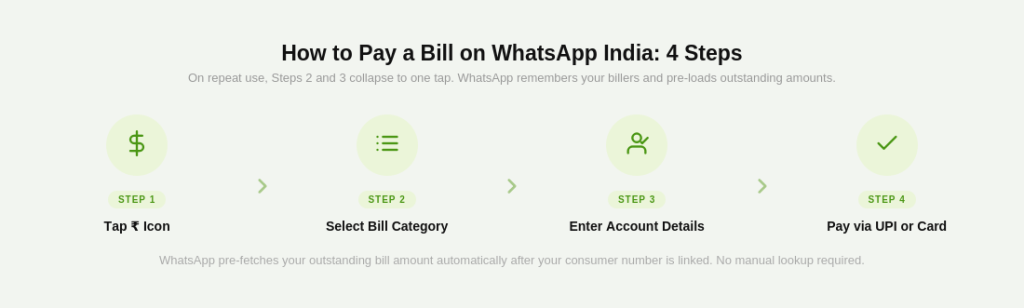
The setup is straightforward and takes under two minutes on first use.
- Open WhatsApp on your Android or iPhone.
- Tap the ₹ icon at the top right of the home screen. If you do not see it yet, the feature has not reached your account as part of the gradual rollout. Update WhatsApp to the latest version and check again over the coming days.
- On the Payments Home screen, tap Pay Bills.
- Select a bill category from the list, such as Electricity.
- Search for or select your biller. For example, MSEDCL for Maharashtra, or BESCOM for Bengaluru.
- Enter your consumer number or account ID for that biller. WhatsApp securely stores this for future payments.
- WhatsApp fetches your outstanding bill amount automatically from the biller’s system.
- Confirm the amount and choose your payment method: UPI, debit card, or credit card.
- Authenticate the payment using your UPI PIN or card details.
- The payment is processed and you receive a confirmation receipt in WhatsApp.
On repeat visits, steps 4 through 7 are replaced by a single tap on your previously paid biller. WhatsApp remembers your consumer numbers and pre-loads your outstanding bill.
WhatsApp Bill Payment vs Google Pay vs PhonePe: Where It Stands
WhatsApp Bill Payment India enters a market that PhonePe and Google Pay have dominated for years. Understanding the competitive position honestly matters for users choosing where to pay bills.
PhonePe and Google Pay together handle more than 85 percent of UPI transactions in India. WhatsApp Pay processed 167.89 million UPI transactions in July 2026, worth Rs 12,957.07 crore, which represents less than one percent of UPI volume. The gap in scale is significant.
WhatsApp’s advantage is not transaction volume. It is context. A payment that happens inside the same app you already use for daily communication removes a category of friction that switching apps creates. If your electricity company sends you a notification on WhatsApp, you can pay it without leaving the conversation. If a family member reminds you about a due date in a WhatsApp group, you can pay it from the same screen.
PhonePe and Google Pay are dedicated payment apps with payment as their entire purpose. WhatsApp is a communication app that handles payments as one of many functions. The bill payment feature is not designed to take 85 percent of the UPI market. It is designed to capture the payments that are most naturally connected to conversations.
The Payments Home pre-fetch feature is a meaningful differentiator. Rather than requiring you to remember to check bills, WhatsApp surfaces outstanding amounts automatically when you open the payments section. This is a convenience layer that standalone payment apps also offer, but it lands differently when it is in the same app you open dozens of times a day.
Why WhatsApp Bill Payment India Matters for Businesses
The bill payment launch is the clearest signal yet that Meta intends WhatsApp to function as a super-app in India, the way WeChat functions in China. This has direct implications for businesses that already use WhatsApp as a customer communication channel.
For businesses in utilities, insurance, lending, and any sector where bill payment is part of the customer relationship, WhatsApp Bill Payment creates a new touchpoint. A customer who can be reminded of a payment due date via WhatsApp Business message and pay it without leaving WhatsApp has a significantly smoother experience than one who receives a reminder and must switch apps.
The combination of WhatsApp Business API messaging and WhatsApp Pay bill payments creates a natural end-to-end flow: send a personalised payment reminder via the API, and the customer pays directly in the same interface. For insurance companies, utility providers, lending institutions, and housing societies that are already communicating with customers through WhatsApp Business, the bill payment feature adds a payment completion layer to a communication flow that was previously missing it.
For businesses building customer communication infrastructure on WhatsApp through platforms like GreenTick.ai, the bill payment launch reinforces the direction WhatsApp is moving in India. Businesses that build deep WhatsApp communication workflows now are positioned to integrate payment reminder flows as WhatsApp’s financial infrastructure expands. The October 2026 service message pricing change, covered in our WhatsApp Business API pricing guide, also affects how businesses will need to structure payment reminder templates going forward.
The Bigger Picture: WhatsApp as India's Financial Super-App
The appointment of Kunal Shah, founder of CRED, as Meta’s global leader for financial products in June 2026 signalled that this bill payment launch was not accidental. CRED built its business specifically around credit card bill payment behaviour, turning routine financial actions into a habit-forming product. Shah bringing that product philosophy to WhatsApp is visible in the design of the Payments Home screen: surfacing bills proactively, keeping frequently used billers accessible, and reducing the steps required for routine payments.
WhatsApp Pay’s transaction growth from 37 million transactions in 2024 to 150 million in June 2026 suggests the platform has been gaining payment traction before the bill payment feature launched. The bill payment feature targets recurring payments, which behave differently from peer-to-peer transfers. A person who pays their electricity bill on WhatsApp once will return to pay it every month. That recurring behaviour is how payment apps build durable market share, and it is the specific behaviour that the bill payment feature is designed to create.
WhatsApp has 500 million users in India. Even at a low single-digit percentage capture of India’s total bill payment volume, the scale would be significant. The question is not whether WhatsApp can become a relevant bill payment platform in India. It already has the distribution. The question is whether the product experience is good enough to displace habits built around PhonePe and Google Pay over several years.
What Most People Get Wrong About WhatsApp Bill Payment India
The most common mistake will be assuming the feature is already on their WhatsApp. The September 3 launch is a gradual rollout. Not every user receives access on day one. If the ₹ icon does not show a bill payment option, updating to the latest version of WhatsApp and waiting a few days is the right first step.
The second mistake is expecting all billers to be available. Bharat Connect covers 22,722 billers, which is extensive, but some regional, local, or newer utility providers may not yet be on the network. If your specific biller is not found, the payment cannot be completed through WhatsApp and you will need to use your usual payment app for that specific bill.
The third mistake is conflating WhatsApp Pay and WhatsApp Bill Payment. WhatsApp Pay has been available in India for several years for peer-to-peer money transfers and merchant payments. Bill Payment is a new layer on top of this existing payments infrastructure, specifically for utility and recurring bill categories.
The fourth mistake is not linking accounts during initial setup. WhatsApp can only pre-fetch outstanding bills for billers where you have linked your consumer number or account ID. The pre-fetch is the most useful part of the feature. Taking two minutes to link your electricity, gas, and water accounts on first use makes every subsequent payment significantly faster.
Conclusion
WhatsApp Bill Payment India is a deliberate move toward making WhatsApp the default financial interface for daily Indian life. Electricity, gas, water, FASTag, insurance, credit cards, and loans represent the recurring financial calendar of every Indian household. Bringing all of it into WhatsApp, the app that already holds the daily communication calendar, is a logical next step that users in countries without this integration will immediately recognise the value of. The feature is live now, rolling out gradually, and the Bharat Connect network it runs on is large enough to cover most of what Indian households pay regularly. Link your billers once and the system handles the rest.
Frequently Asked Questions About WhatsApp Bill Payment India
When did WhatsApp Bill Payment India launch?
WhatsApp Bill Payment India launched on September 3, 2026. Meta announced the feature through its official newsroom. The rollout is gradual, with access expanding to all Android and iPhone users across India over the coming weeks from that date.
How do I access WhatsApp Bill Payment in India?
Tap the ₹ icon at the top right of the WhatsApp home screen. This opens the Payments Home, where you can access bill payment, view outstanding amounts, and manage your linked billers. If the bill payment option is not visible, update WhatsApp to the latest version and check again over the following days.
What bills can I pay on WhatsApp in India?
WhatsApp Bill Payment covers 22,722 billers across 30 categories through the Bharat Connect network. Categories include electricity, piped gas, water, FASTag toll payments, insurance premiums, credit card bills, loan repayments, telecom postpaid bills, DTH and cable TV subscriptions, municipal taxes, and more.
What payment methods are available for WhatsApp Bill Payment India?
You can pay using UPI, debit card, or credit card. The same payment options available in WhatsApp Pay for money transfers and merchant payments apply to bill payments.
Is WhatsApp Bill Payment India safe?
Yes. WhatsApp Bill Payment operates through the Bharat Connect network, which is regulated by the Reserve Bank of India. Payments are processed through the existing WhatsApp Pay infrastructure, which uses the same UPI framework as PhonePe and Google Pay. No bill payment data is shared with contacts or visible in your chat messages.
Can I pay bills for multiple connections on WhatsApp?
Yes. WhatsApp Bill Payment allows you to manage multiple accounts under a single provider. For example, you can link the electricity connection for your home, office, and a rental property all under the same electricity board and pay each separately from the Payments Home screen.
Is WhatsApp Bill Payment available outside India?
No. The Bharat Connect network is India-specific infrastructure. WhatsApp Bill Payment India is a feature built for the Indian market and is not available in other countries at this time. WhatsApp has not announced plans to extend the bill payment feature to other markets.